.png)

I've watched this unfold a dozen times. A marketing team pours $50,000 into a campaign, generates hundreds of "qualified" leads, and sends them to sales. Sales glances at the list, sighs, and ignores half of them because they seem irrelevant. Marketing feels ignored. Sales feels unsupported. And the buyer gets a confusing, inconsistent experience.
Having been on both sides of that friction, I've sat in sales meetings where marketers weren't invited and marketing meetings where sales input was an afterthought. From experience, that internal misalignment costs far more than bad messaging ever will.
The companies I've worked with—those that scaled from 0 to 1 or 1 to 10—all had one thing in common: they figured out how to align sales and marketing around the same accounts. Not eventually. But early. That alignment is what separates companies that grow predictably from ones that burn cash and call it "learning."
This is what I've learned about Account-Based Marketing, and why it's become my go-to playbook for generating demand that actually converts.
What Is ABM Strategy (And Why It Matters Now)
Account-Based Marketing isn't new. But the way I use it has evolved.
At its core, ABM is simple: forget the spray and pray approach. Here's the traditional ABM definition:
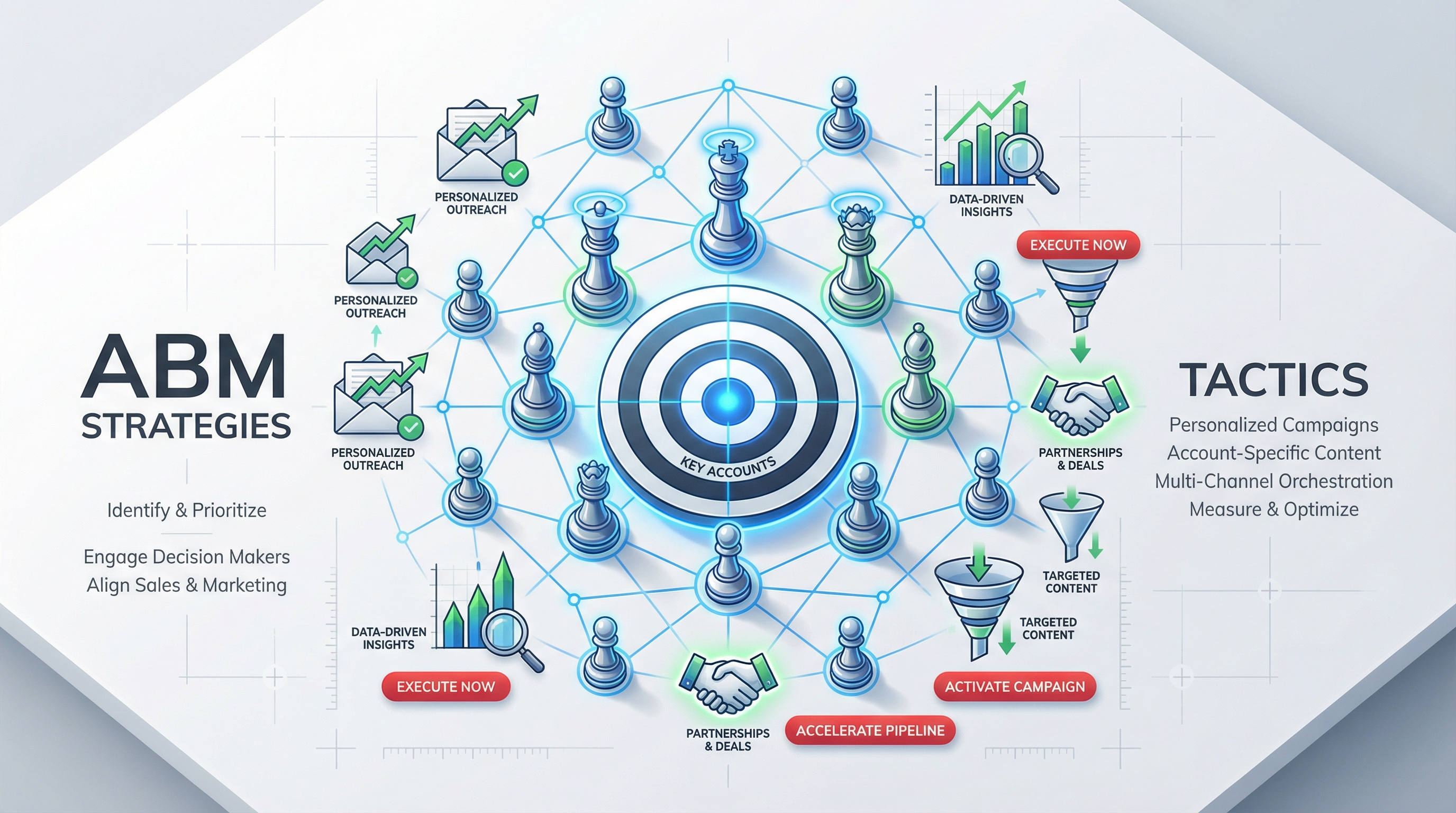
Account-Based Marketing (ABM) strategies increase ROI by treating high-value companies as individual markets rather than broad groups. Success relies on aligning sales and marketing teams to engage specific decision-makers through personalized landing pages, intent data, and custom content. Common tactics include using LinkedIn for account-specific ads and automated "warm" outreach based on real-time engagement signals.
By definition, it's simply about targeting decision makers using personalized messaging and assets. However, the execution isn't easy; it's difficult.
My approach starts with a specific set of high-value accounts, aligns the entire organization around winning them, and builds personalized campaigns for each one. Treating each account as its own market—not as a lead in a funnel—fundamentally changes the math.
Unlike traditional marketing where volume matters, ABM flips the funnel. The best-fit accounts get identified first. Then everything—messaging, content, channels, timing—is built around them. When sales and marketing teams unite around the same target accounts, progress accelerates and deals close larger. The result: 208% more revenue from aligned teams compared to those running traditional campaigns.
That's not exaggeration. I've measured this multiple times across different products.
The shift matters because B2B buying has changed significantly. Purchase decisions now involve buying committees, not individual champions. Companies are bigger. Price expectations are higher. The stakes demand reaching the right decision-makers with the right message at the right time. Broadcasting generic campaigns doesn't accomplish that.
Data backs this up. In 2025, 80% of B2B marketers increased spending on ABM. The trend continues because it works. But here's what most miss: ABM only works if there's discipline about it. And discipline is harder than technology.
How ABM Differs from Traditional Marketing
| Traditional Marketing | ABM |
|---|---|
| Broad audience targeting | Targeted high-value accounts |
| Generalized messaging | Personalized outreach for decision makers |
| Leads measured by volume | Engagement depth and revenue impact |
| Separate sales and marketing goals | Shared target account strategy |
| Long, unpredictable sales cycles | Faster deal progression |
Most practitioners run both. Traditional marketing is easier to execute and easier to hide behind. "We generated 500 leads" sounds impressive until realizing 450 of them are worthless.
ABM forces honesty. With 10 target accounts and 3 conversions, the results are crystal clear. There's nowhere to hide.
Define Your Ideal Customer Profile and Build Your Target Account List
This is where to start. Always.
Start by documenting an Ideal Customer Profile based on firmographic and technographic traits. Ask yourself these questions repeatedly:
- What company size closes deals?
- What industries convert best?
- What geographic markets see the highest engagement?
- What technology stack signals buying intent?
- What revenue potential justifies the investment?
At my last marketing role, we were selling to industrial teams. Rather than targeting every company using industrial XR tools, the focus was on companies with 50-500 employees in specific verticals using XR platforms. That specificity mattered. The more granular the targeting became, the more accurate the results.
Once the ICP is locked in, build the Target Account List. Rank accounts by fit and opportunity. The top tier—typically 10-20 accounts—gets white-glove treatment. The second tier gets structured outreach. The third tier gets programmatic tactics.
One constant mistake: building TALs that are too large. If personalized outreach can't be delivered to every account, it's too big. A 60% close rate on 15 accounts beats a 5% close rate on 150 accounts. The math is better. Team morale is better. Revenue actually moves.
Segment Accounts by Tier and Customize Your Approach
I learned this lesson the hard way early in my career at Simform.
All target accounts were being treated the same. Tier 1 accounts—the biggest opportunities—received the same templated email sequences as Tier 3 accounts. No wonder conversion rates suffered.
Now the approach is tiered ruthlessly.
Tier 1 Accounts (Your Biggest Opportunities) These require personal handling. Custom content built specifically for them. Direct outreach from the CEO or VP of Sales. Event invitations. One-on-one conversations with key stakeholders. Personalized gifts. When pursuing a company where the deal could be $100K+, nothing gets automated.
Tier 2 Accounts (Solid Mid-Market Opportunities) These get a structured playbook. Targeted LinkedIn ads with personalized creative. Personalized email sequences. Industry-specific landing pages. Webinar invitations. Still personalized, but less resource-intensive than Tier 1 and not templated.
Tier 3 Accounts (Programmatic Focus) Segmented LinkedIn ads. Educational content. Retargeting. Automated email campaigns. Ten hours per account isn't spent here. But they're not ignored either.
This approach maximizes ROI. Best salespeople don't burn out on accounts with minimal upside. Biggest opportunities don't get treated like leads in a mass campaign. That's the balance.
Build a Solid Data Foundation Using Intent Data and Audience Intelligence
Paying attention to intent data about three years ago changed everything.
Intent data reveals when an account is actively considering a solution like ours. There are two types:
First-party data: Which accounts visit our website? Which open our emails? Which download our content? Which engage with our brand? All of this is visible.
Third-party intent data: When prospects search for related keywords, read industry reports, engage with competitor websites, or show other buying signals—tools like 6sense, Userled, and Demandbase provide this insight. When Company X suddenly increases searches for "marketing automation," they're in active buying mode. That's the signal to move fast.
Early in my career, a generic email would have been sent to that company. Now the approach is different. An outreach sequence gets coordinated. The AE gets on a call within 48 hours. Movement happens before they're already in talks with a competitor.
Here's the hard truth: bad data kills all of this. If the target account list contains outdated contact information or inaccurate company profiles, campaigns fail before they start. I've learned to invest time in data validation. Clean data beats flashy campaigns every time.
When each account's pain points, buying timeline, and decision-makers are understood, messaging stops feeling generic and starts feeling relevant. That's when things move.
Align Sales and Marketing Goals—Your Foundation for Success
Let's be direct: ABM only works if sales and marketing teams operate as one.
I've been in companies where they didn't. Marketing would build one target list. Sales would pursue another. Conflicting definitions of "sales-ready" existed. A prospect sent to sales would get rejected because it wasn't a fit. It was chaos.
Now alignment meetings start everything. Both teams agree on which accounts deserve pursuit and in what order. Success metrics get defined together. Sales cares about pipeline and revenue. Marketing cares about engagement and influence. But both care about the same target accounts.
Clear handoff points also get established. When does marketing pass a lead to sales? What constitutes "sales-ready" in this context? These criteria get documented so both teams understand expectations.
Here's what works: pod structures for Tier 1 accounts. An Account Executive, an SDR, and an ABM manager work together as a unit on each account. Weekly syncs happen. Data gets shared in real time through Slack. When marketing uncovers an intent signal, sales knows immediately. When sales learns a prospect has implementation concerns, marketing adjusts the messaging.
The payoff is measurable. Teams with tight alignment see 208% more revenue from ABM campaigns than those without it. The difference is night and day.
Create Personalized Messaging for Each Account
Generic content doesn't work in ABM. This lesson came from sending the same webinar invitations to every prospect. Nobody came. Then webinars became tailored to specific industries and challenges. Suddenly attendance improved.
Start by developing buyer personas for each target account. Who are the decision-makers? What are their individual goals and challenges? What does success look like for them?
Then create content tailored to each role. The CFO cares about cost and ROI. The CMO cares about brand impact and lead generation. The CTO cares about implementation and security. Same product. Completely different messages. The same email can't go to all three.
Personalized landing pages are particularly effective. ABM campaigns using custom landing pages see 202% higher engagement than generic pages. When a prospect lands on a page that speaks directly to their industry, uses their language, and addresses their specific pain points—engagement changes.
Several asset types get created:
- Tailored case studies from companies in their industry
- Custom research addressing their specific challenges
- Solution decks showing how we solve their problems
- Interactive demos configured to their use case
- Industry-specific whitepapers
- Video messages from executives
Here's the scaling trick: brand-new content doesn't get created for every single account. Identify what resonates, then adapt and amplify it. A successful webinar becomes an on-demand video series. An email sequence becomes a LinkedIn InMail campaign. A landing page becomes a case study for similar industries.
That's how personalization scales without burning out the team.
Coordinate Multi-Channel Engagement to Stay Top-of-Mind
Early in my career, one channel would be chosen and pursued all-in. Email campaign. Or LinkedIn ads. Or webinars. Then I'd wait for results.
That approach changed. ABM doesn't work through a single channel. It works through coordinated campaigns across multiple touchpoints.
LinkedIn is foundational. Account-based LinkedIn ads reach exact target accounts with personalized creative. The focus is benefit-driven angles—speed, conversions, trust, ROI. Show the outcome, not the feature.
Email remains critical. Personalized subject lines increase open rates by 26%. Segmented lists increase revenue by 760%. But cold email alone doesn't move the needle. Email works best combined with other touchpoints.
Direct mail surprised me when first tried. One company sent curated gifts to executives with handwritten notes. The response rate was 22%. Why? Because it's unexpected. Everyone's inbox is full. A physical package stands out.
Events create the deepest relationships. Face-to-face time with decision-makers builds trust in a way digital channels never can. These don't need to be large conferences. Smaller, curated dinners with industry peers often outperform.
Emerging channels are worth testing. Connected TV (CTV) for highly targeted video. Podcasts for thought leadership. TikTok for B2B (yes, really—it works for certain industries).
The key is coordination. The prospect sees a LinkedIn ad on Monday. Receives a personalized email on Wednesday. Gets a podcast speaker invitation on Friday. Each touchpoint builds on the last. That's what creates the "always in view" effect that drives engagement.
Core ABM Strategies That Drive Results
Over the years, what actually works has been distilled into five core strategies.
1. Identify High-Value Target Accounts
Start by choosing accounts that matter most. Not the largest list. The list most likely to convert into long-term revenue.
Analyze firmographics, historical data, and intent signals to qualify accounts early. Here's a trick I learned: start with the highest-value customer base and reverse-engineer what made them successful. Then find similar companies. If Company A is a perfect fit and worth $50K in ARR, find three more Company As, not 100 random prospects.
2. Build Personalized Messaging for Each Account
Once target accounts get identified, customize messaging based on their specific needs, industry context, and pain points. Content speaks to decision-maker priorities, not general industry trends.
3. Execute Targeted List Building
Prioritize companies with strong fit and growth potential. Outreach is far more effective when starting with a focused target list instead of a broad contact pool.
Use data enrichment tools like Apollo and Clay. They help identify decision-makers and validate contact information. Bad contact info wastes time. So clean the list obsessively.
4. Deploy Executive Outreach Campaigns
Combine digital campaigns with one-to-one outreach from sales leaders. Personalized video messages or executive-level invitations add credibility and increase engagement likelihood.
Don't ask for an initial sales call. Offer something of value. A webinar appearance. An exclusive event. An introduction to another helpful executive. This approach works because it feels generous, not transactional.
5. Measure Impact at the Account Level
Count revenue, not leads. Track metrics like pipeline velocity, deal progression, content engagement, and revenue influenced by ABM efforts.
Here's what I've learned: if a campaign can't be tied to revenue, don't run it. Vanity metrics are worthless. Influenced revenue is what matters.
Close the Gap: How to Execute Multi-Touch Campaigns
Hundreds of sequences have been tested. This is what works.
Example Sequence:
- Prospect receives personalized LinkedIn ad
- SDR sends personalized email with specific insight relevant to their company
- Follow-up call with AE offering executive briefing
- Invitation to exclusive webinar or industry event
- Post-event personalized email with case study
- Direct mail package with curated gift
- LinkedIn follow-up conversation continuing the dialogue
Track engagement at each step. Which content assets drive interaction? Which sequences push deals forward? Use this data to refine tactics and improve future campaigns.
The goal is consistency and coordination, not exhaustion. The prospect should recognize the pattern. Monday LinkedIn. Wednesday email. Friday something else. They start expecting the outreach. That's when conversions happen.
ABM in Practice: Real-World Examples
Here's what I've seen work:
Software Provider Success A software company identified their top 10 enterprise accounts and launched personalized campaigns with direct outreach and tailored content. Their sales cycle shortened because prospects engaged more meaningfully around specific business outcomes. They didn't need hundreds of leads. They needed to close 3-4 of their top 10. They focused accordingly.
Technology Company Using Personalized Webinars I ran this one personally. We created webinar topics specific to each account's industry and challenges. Instead of sending a generic "product overview" webinar to everyone, we sent industry-specific webinars to specific accounts. Engagement rates improved 3x compared to traditional email blasts.
The Curated Gift Approach Sending curated gifts to executives with coordinated digital touchpoints got tested. When executed thoughtfully with genuine personalization, it worked. We saw a 22% response rate. The cost per response was higher than email. But the quality of conversation was completely different.
SaaS with Data-Driven Targeting At my last company, we focused on 100 accounts across three tiers. Apollo and Clay enriched company data and identified technology stacks. We filtered accounts by growth potential and removed anyone who had already converted. LinkedIn ads and personalized email launched, then events expanded the efforts. Result: qualified pipeline doubled in Q1.
Podcast Guest Invitation Strategy One colleague ran this approach. Instead of asking for a sales call, we invited target executives to appear as podcast guests. This provided value to the executive (a platform) and built relationship without being salesy. It worked because it felt generous, not transactional.
Pipeline Impact in Numbers I've seen Userpilot generate over $900,000 in pipeline with just $8 spent per dollar of pipeline. That's a 12.5x return. That level of precision comes from tracking influenced revenue rigorously, not counting vanity metrics.
Measure What Matters: Influenced Revenue and Pipeline Velocity
Most marketers measure the wrong things. They track clicks, impressions, form submissions. I've done this. It feels productive. It's not.
Focus on metrics that actually predict revenue.
Metrics that drive decisions:
- Influenced revenue: How much revenue did this campaign contribute?
- Pipeline velocity: How fast did opportunities move through the funnel?
- Account penetration: How many decision-makers at the account got reached?
- Time-to-close: Did ABM actually shorten the sales cycle?
- Deal size: Did ABM increase average contract value?
- Engagement depth: Which content assets drive interaction with multiple stakeholders?
- Win rate by account: Are we closing a higher percentage of Tier 1 accounts?
How to measure effectively:
- Connect the data: Integrate the marketing platform with the CRM so the full journey from first touch to closed deal gets tracked
- Track at account level: Don't aggregate metrics. Measure by account and by campaign.
- Review quarterly: Ask what worked, what didn't, and where resources shift next quarter
- Build dashboards: Use analytics tools to monitor engagement and pipeline in real time
When we can prove that ABM campaigns drove $3M in closed revenue this quarter, budget conversations go differently next quarter. That's the conversation that matters. Not "how many leads did we generate."
ABM Strategy Framework You Can Use
Here's the approach used across every company:
Step 1: Account Qualification Define the ideal customer profile and establish criteria for account selection. Consider revenue potential, industry match, strategic fit, growth trajectory, and technology alignment.
Step 2: Collaborative Planning Get sales and marketing teams together to map current relationships, needs, and messaging frameworks for each target account. Agree on success metrics and communication cadence upfront.
Step 3: Tailored Asset Development Build personalized content—customized decks, case studies, solution demos, videos, webinars that speak directly to account challenges. Create buyer persona-specific assets for each decision-maker role.
Step 4: Multi-Channel Execution Run campaigns across channels where target decision-makers engage. Social ads, email sequences, direct mail, executive events should lift brand presence and nurture relationships. Coordinate timing so touchpoints reinforce each other.
Step 5: Measurement and Iteration Monitor engagement and revenue impact, then adjust messaging and execution based on what works best for each account. Share learnings across the team. Optimize monthly, not quarterly.
Tools That Support ABM Execution
Different tools work for different companies, but here's what actually matters:
- CRM platforms: Support account segmentation, scoring, and deal tracking (Salesforce, HubSpot)
- Marketing automation: Enable personalized sequences at scale (HubSpot, Marketo, Pardot)
- Intent data platforms: Identify accounts showing purchase signals (6sense, Userled, Demandbase)
- Account-based advertising networks: Precision targeting across channels (LinkedIn, 6sense, Demandbase)
- Enrichment tools: Add decision-maker contact info and firmographics (Apollo, Clay, RocketReach)
- Analytics dashboards: Monitor engagement and pipeline (custom dashboards, BI tools)
- ABM orchestration platforms: Automate coordination across teams and channels (Outreach, Salesloft)
These tools make execution easier and faster. But here's what I've learned: tools don't drive ABM success. Discipline does. The commitment to precise targeting, consistent personalization, and tight sales-marketing alignment determines whether ABM works.
I've seen companies with fancy tools and no discipline generate nothing. I've seen companies with basic tools and disciplined execution scale predictably. The latter always wins.
Start Small, Learn, Then Scale ABM Tactics
Don't start big. Start small and prove the model before scaling.
Phase 1: Pilot (Month 1-3)
- Select 5-10 target accounts
- Pick 2-3 tactics to feel confident in
- Run for one quarter
- Measure everything meticulously
Phase 2: Analyze and Optimize (Month 3-4)
- Which accounts showed the most engagement?
- Which channels drove the best response?
- Which messaging performed best?
- Identify top-performing tactics
Phase 3: Expand (Month 5-9)
- Shift budget to what's working
- Kill tactics that underperform
- Expand the target list by 2-3x
- Add one new channel or tactic once basics are proven
Phase 4: Scale (Month 10-12)
- Double down on proven approaches
- Invest in tools and process automation
- Train the team on refined playbooks
- Set aggressive goals for next year
This approach reduces risk. The whole year doesn't get bet on an untested strategy. Learning happens systematically and improvements compound each quarter.
The Bottom Line: ABM Is Just Good Judgment Applied Rigorously
ABM works because it respects how B2B buying actually works.
- Buying committees are large
- Decisions take time
- Trust matters more than features
- Personalization and relevance drive engagement
- Alignment between teams multiplies effectiveness
Fancy technology isn't needed to run ABM. Discipline is needed. Identify the best-fit accounts. Deliver personalized value. Get sales and marketing teams treating the same accounts as the priority.
I've taken companies from 0 to 1 and 1 to 10 using these principles. The companies that won were the ones that got this right early.
Your action plan:
- Audit your current target account list. Are you pursuing the right companies?
- List your top 10 accounts
- Assign them tiers (Tier 1, 2, 3)
- Define what personalized outreach looks like for each tier
- Run one quarter of coordinated campaigns
- Measure results rigorously
- Optimize based on data
That's it. Not complicated. But executed well, it doubles pipeline velocity and triples deal sizes.
ABM creates a measurable advantage in competitive B2B environments. It treats each account as its own market, making messaging more relevant, interactions more meaningful, and results more predictable.
That's how we move from hoping our marketing works to knowing it does.